Summary
- Question
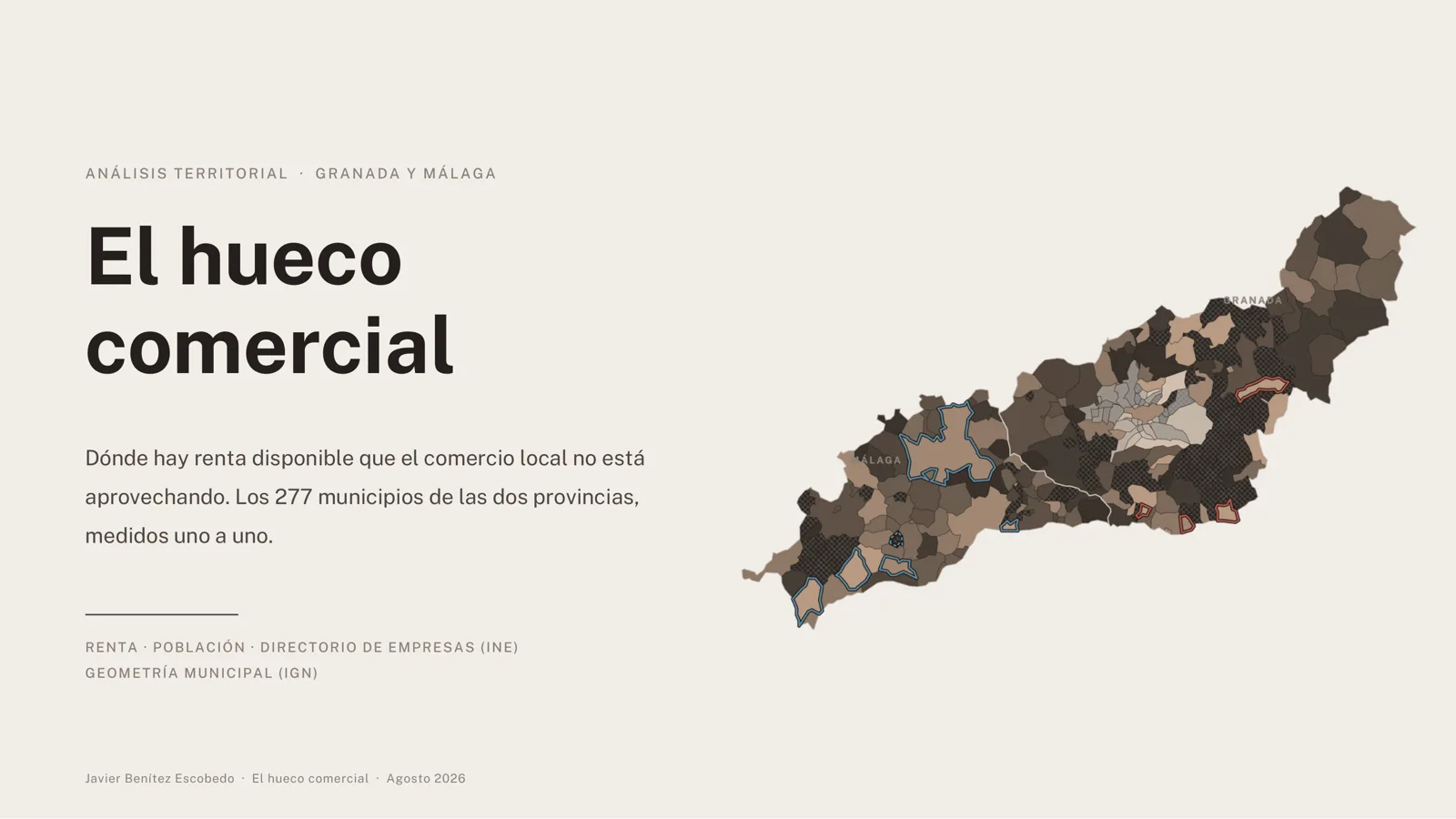
- Where is there money that local retail is not capturing?
- Result
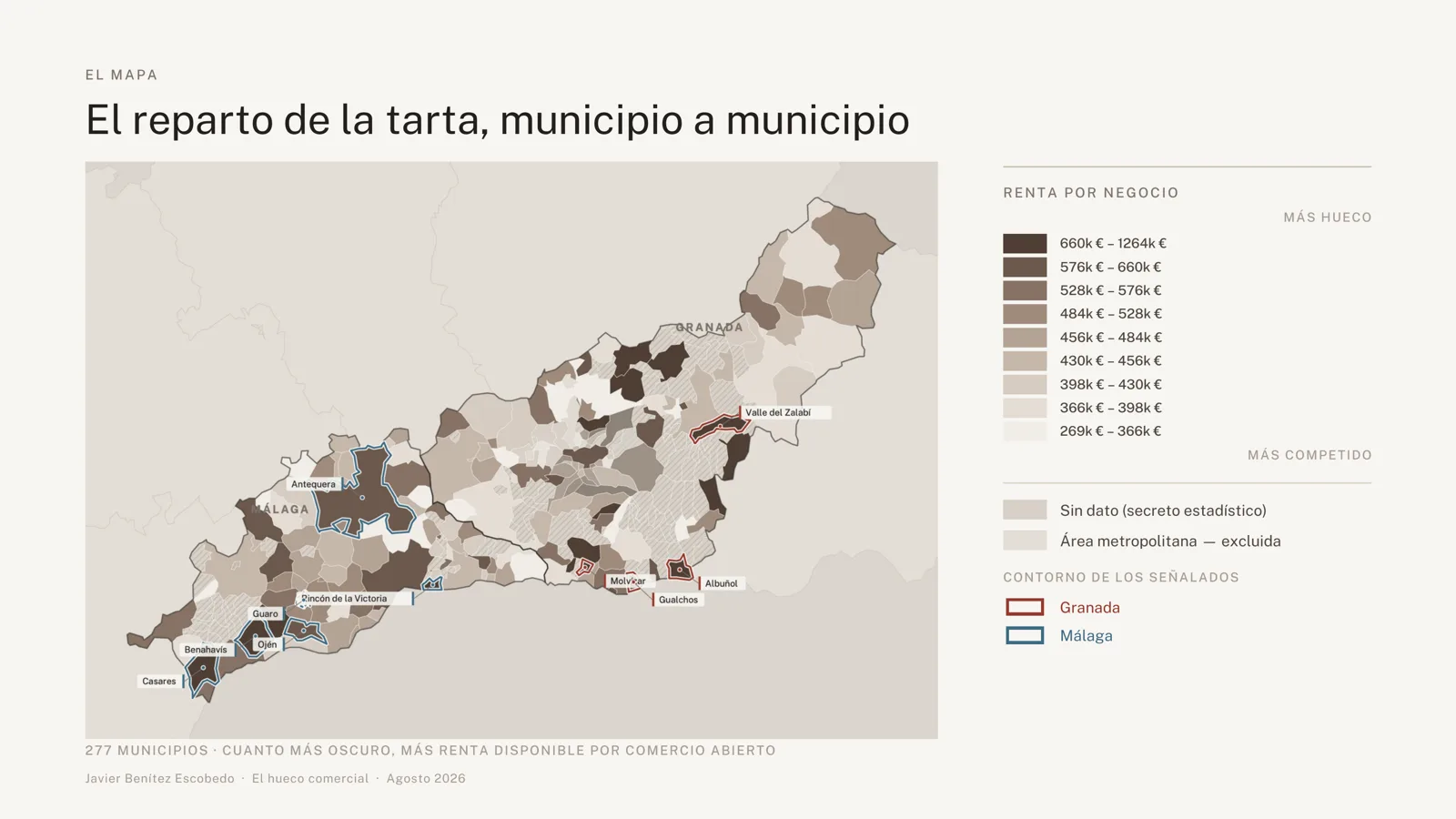
- Out of 277 municipalities, only Rincón de la Victoria and Antequera combine a large market, high income and too little retail, confirmed by three independent measures.
- Tools and sources
- SQL · Looker Studio · INE · IGN
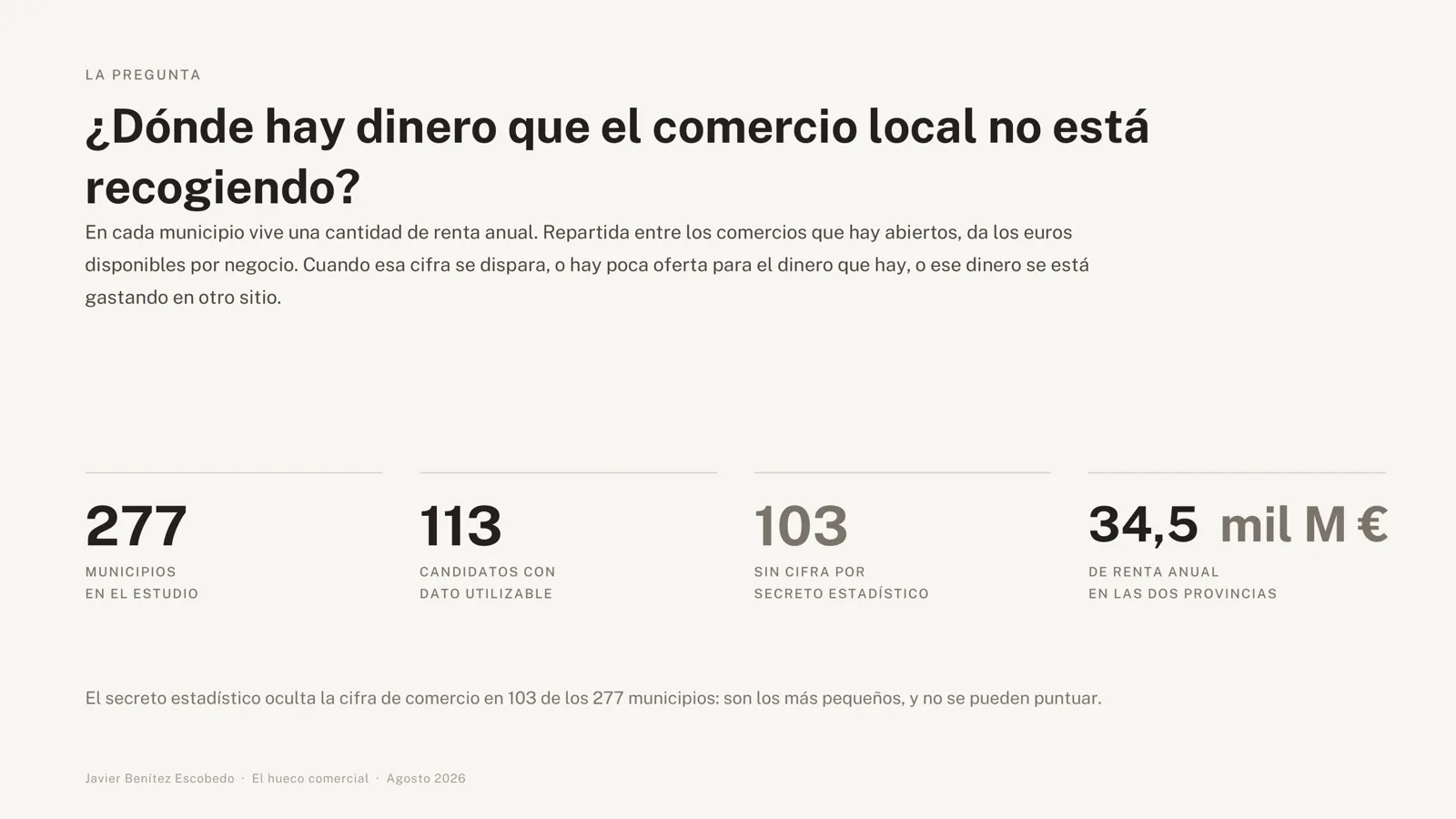
277
municipalities in the study
113
candidates with usable data
103
without figures due to statistical confidentiality
€34.5bn
of annual income across both provinces
The question
Where is there money that local retail is not capturing?
Every municipality holds a certain amount of annual income. Divided by the number of open shops, it gives the euros available per business.
When that figure shoots up, either there is little supply for the money available, or that money is being spent somewhere else. Who it is for: whoever decides where to open a shop or a franchise.
The metric
Disposable income per business.
Formula(income per person × population) ÷ shops
What it signals
Little supply for the money available, or money that leaves to be spent elsewhere. A high ratio is a sign that there is room.
What it is not
It is not turnover or unmet demand. Not all that money is spent in local shops, and the indicator does not say which sectors are missing.
Real example · Molvízar (Granada, INE 18133): income per person €10,188, population 2,752, total income €28.0M, 32 shops → €876,168 per shop, the highest ratio in either province.
The funnel
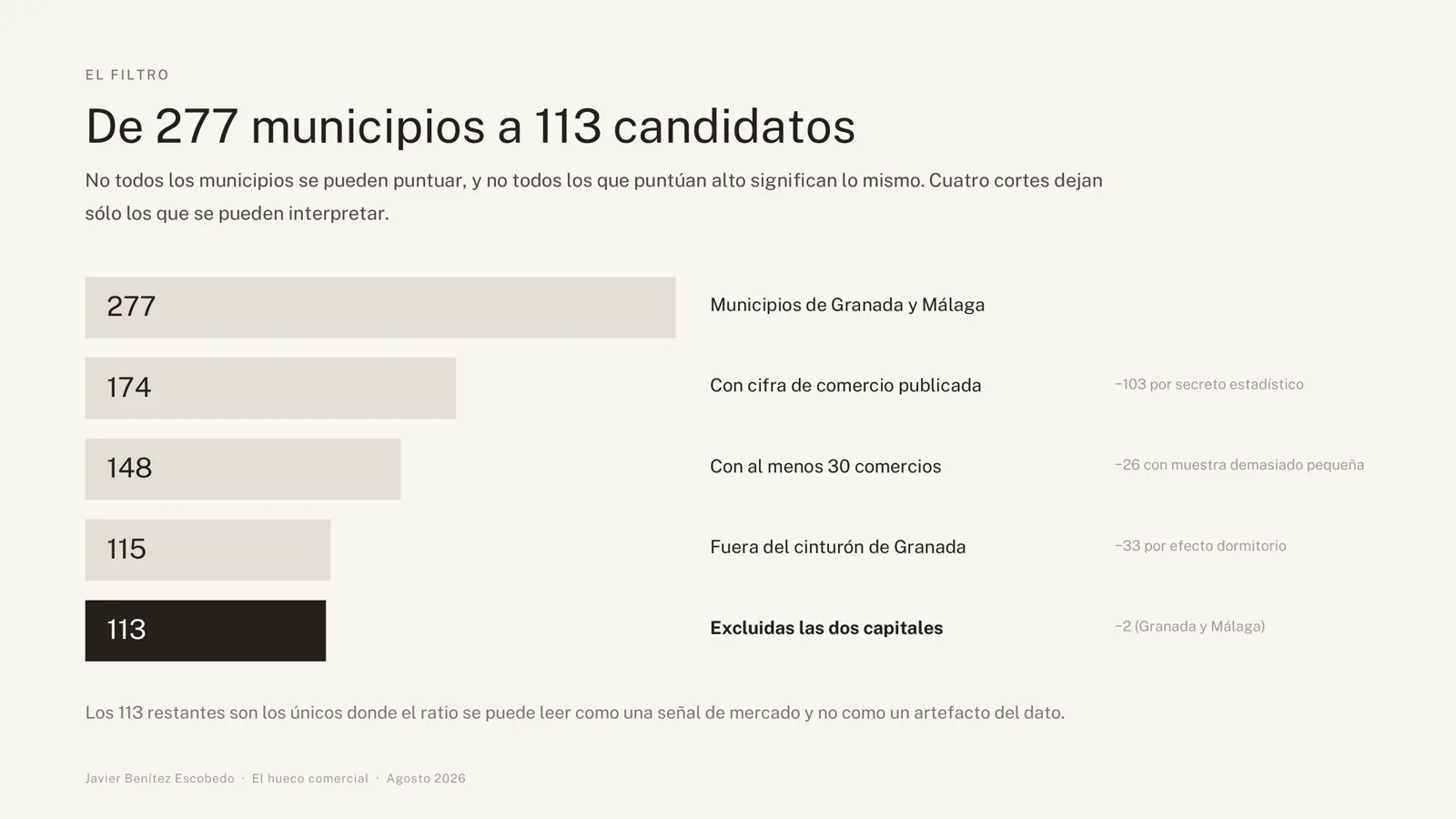
From 277 to 113 municipalities.
- Municipalities of Granada and Málagastarting point
- With a published shop count−103 due to statistical confidentiality
- With at least 30 shops−26 with too small a sample
- Outside the Granada commuter belt−33 due to the dormitory-town effect
- Excluding both provincial capitals−2 (Granada and Málaga)
The remaining 113 are the only ones where the ratio can be read as a market signal rather than a data artefact.
Findings
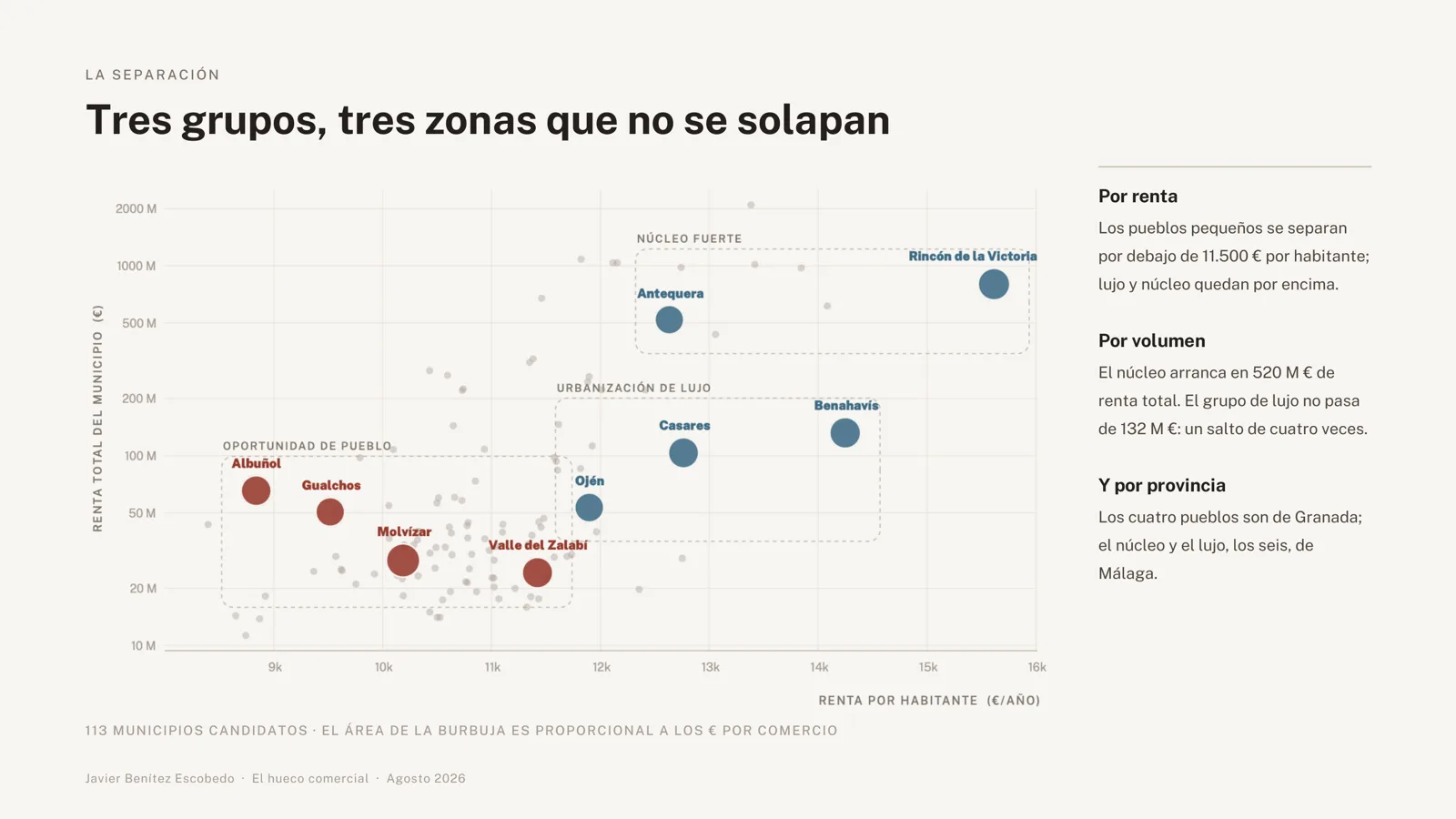
Three groups with the same high ratio and different mechanisms.
Strong core · confirmed by three metrics
A large market, a high ratio and fewer shops than they should have.
- Rincón de la Victoria (Málaga): €754,946 per shop · adjusted €349,540 · 51,300 inhabitants · 1,061 shops · 20.7 per 1,000 inhabitants · total income €801.0M · percentiles: ratio P99, scarcity P80, volume P94.
- Antequera (Málaga): €594,516 · adjusted €275,261 · 41,178 inhabitants · 875 shops · 21.2 per 1,000 inhabitants · €520.2M · ratio P92, scarcity P75, volume P91.
Among municipalities with more than 25,000 inhabitants, they have the lowest shop density (20.7 and 21.2 per 1,000 inhabitants, against 23–32 for the rest).
Village opportunity
The ratio shoots up because there are hardly any shops: there is room for one business, not a chain.
All four in Granada, between 2,100 and 7,400 inhabitants: Molvízar €876,168 · Valle del Zalabí €690,541 · Albuñol €666,623 · Gualchos €587,522.
Luxury developments · different mechanism
Very high income and few shops, because residents shop in Marbella, fifteen minutes away.
This is not recoverable spending leakage. Benahavís €715,807 · Casares €685,568 · Ojén €598,911.
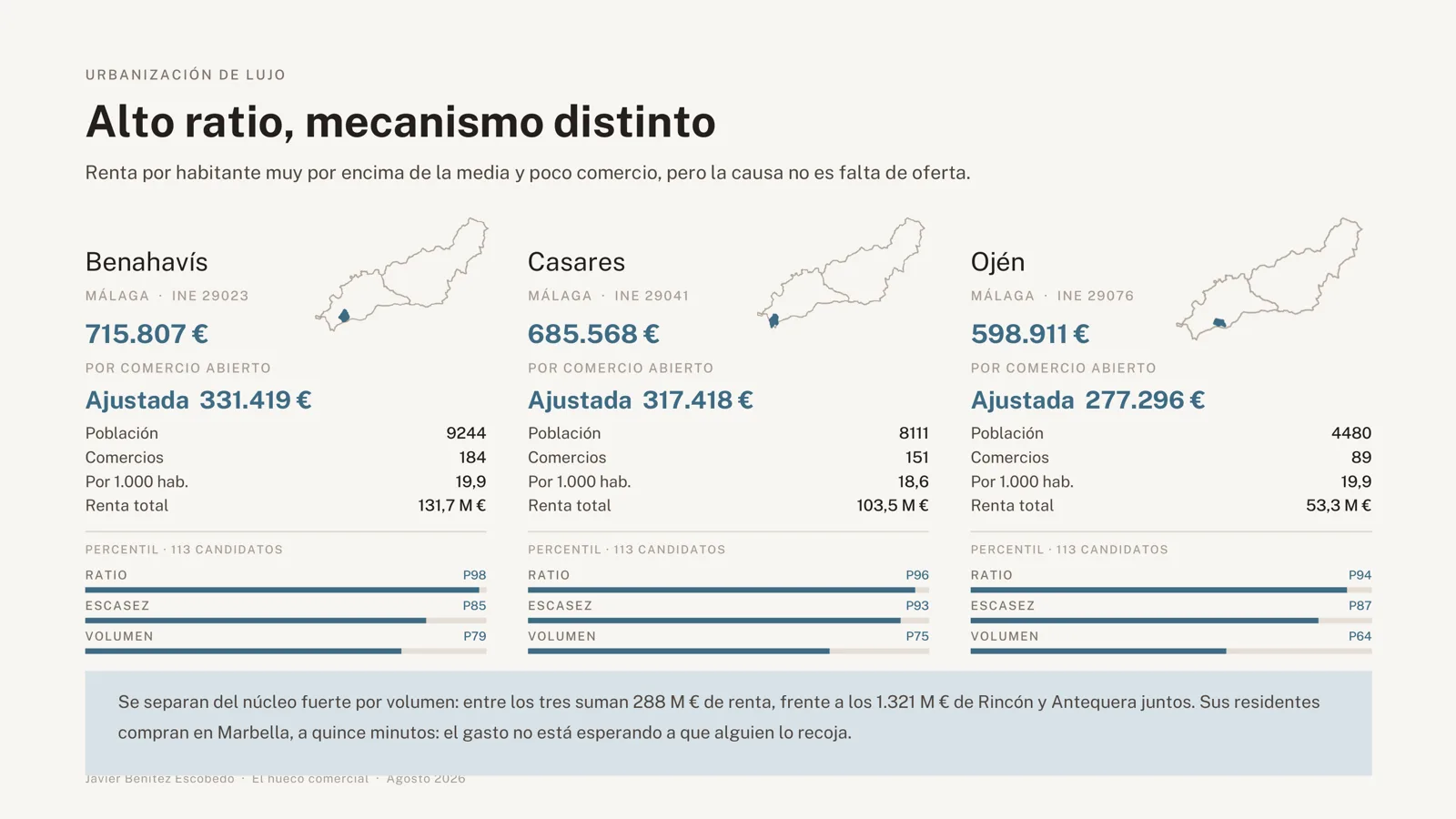
Candidate that cannot be confirmed: Guaro (Málaga), 2,307 inhabitants and €24.9M of income, but INE withholds its number of shops.
What separates the groups
Income (the villages are below €11,500 per inhabitant), volume (the core starts at €520M of total income; the luxury group does not exceed €132M) and province (the four villages are in Granada; the core and the luxury group, in Málaga).
Check
Adjusting for spending changes the scale, not the order.
According to INE's Household Budget Survey (2023), 46.3% of average spending goes on food, clothing, furniture, transport and restaurants. Applied as a constant factor, the ranking does not move.
| Province | Municipalities | Inhabitants | Income | Shops | Median €/shop | No figure |
|---|---|---|---|---|---|---|
| Granada | 174 | 930,181 | €11.82bn | 21,990 | €485,931 | 73 (42%) |
| Málaga | 103 | 1,751,600 | €22.66bn | 44,527 | €456,133 | 30 (29%) |
Limitations
What this analysis does not answer.
- 103 municipalities cannot be scored because of statistical confidentiality, precisely the smallest ones. The list shows where the best gap is among those that can be measured.
- The luxury group does not separate by income (Benahavís €14,248 per inhabitant against Rincón's €15,614): what separates them is the mechanism and the geography, a judgement based on context.
- What actually decides the business is missing: which sectors are lacking, what a shop unit costs, how people move between municipalities.
How to use it
A high ratio shows where to look, not what to open.
- Rincón de la Victoria and Antequera: drill down by business sector.
- The four villages in Granada: check trips to the main town of the district before deciding.
Conclusion
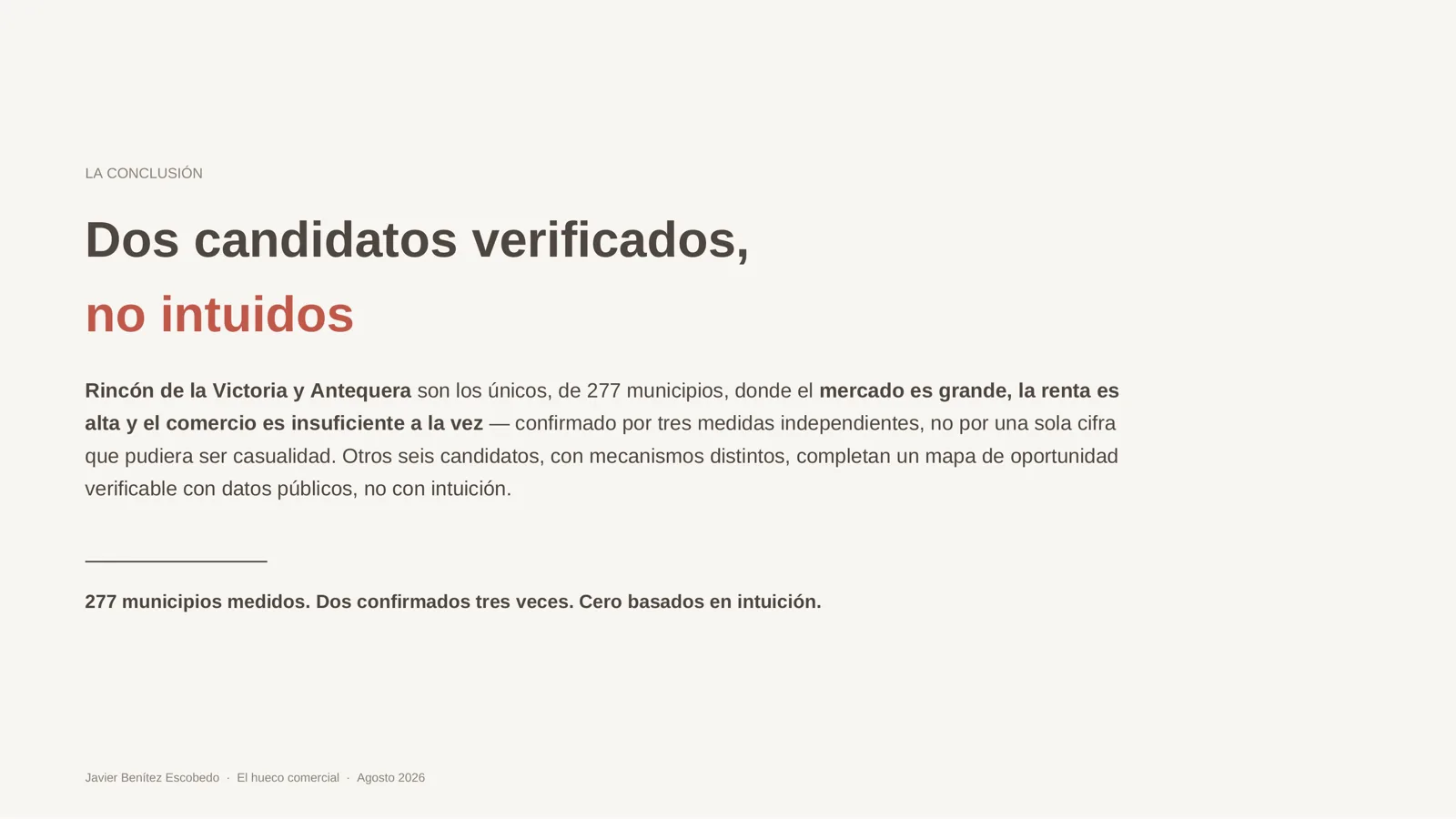
277 municipalities measured. Two confirmed three times. None based on gut feeling.
Rincón de la Victoria and Antequera are the only ones, out of 277 municipalities, where the market is large, income is high and retail is insufficient at the same time, confirmed by three independent measures.