Summary
- Question
- Is your loyalty-card discount real, or does it only offset a higher starting price?
- Result
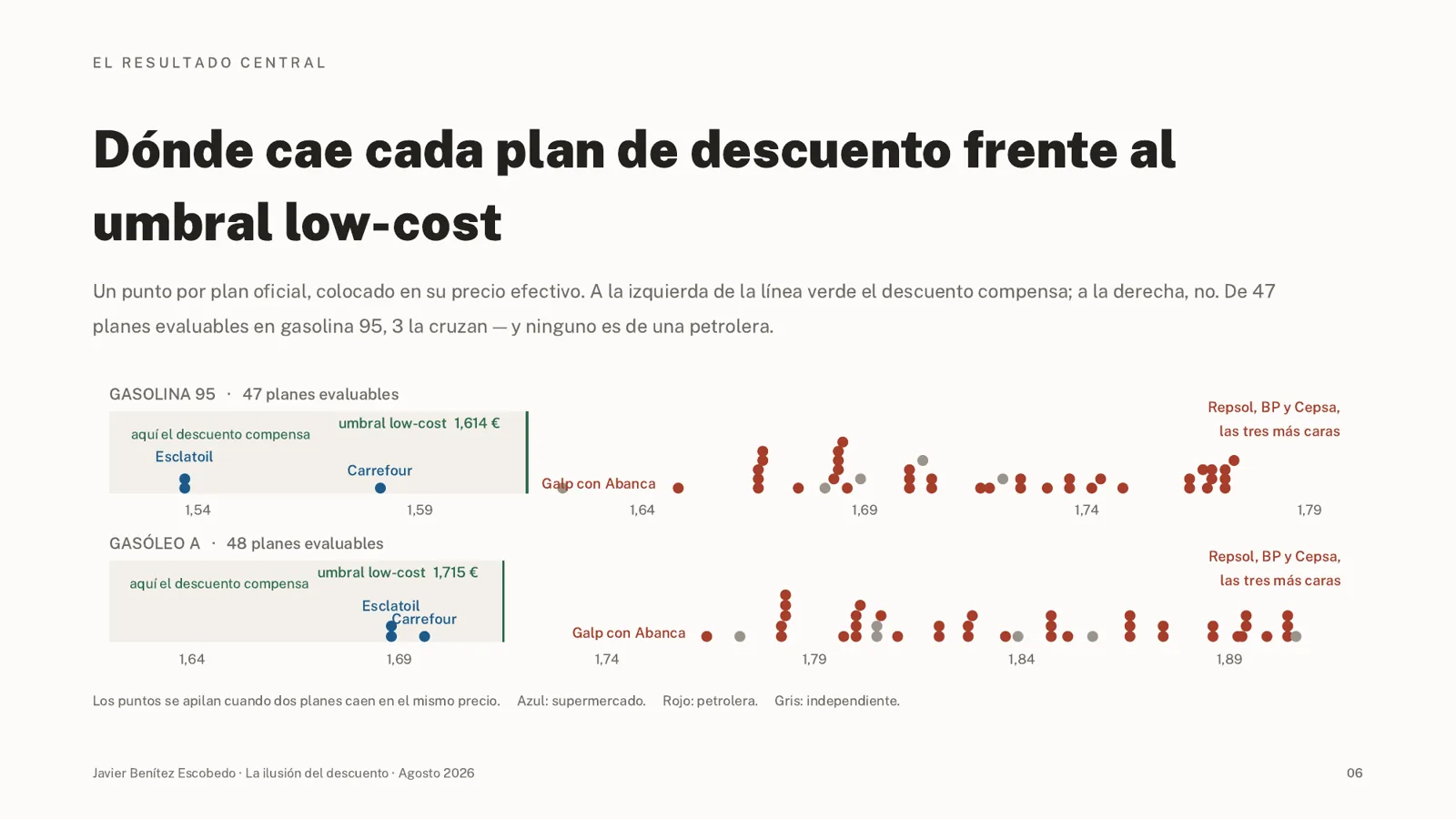
- Of 47 assessable official plans, 3 go below the price a driver already pays without a card at a low-cost station. None of them belongs to an oil company.
- Tools and sources
- SQL · Looker Studio · MITECO
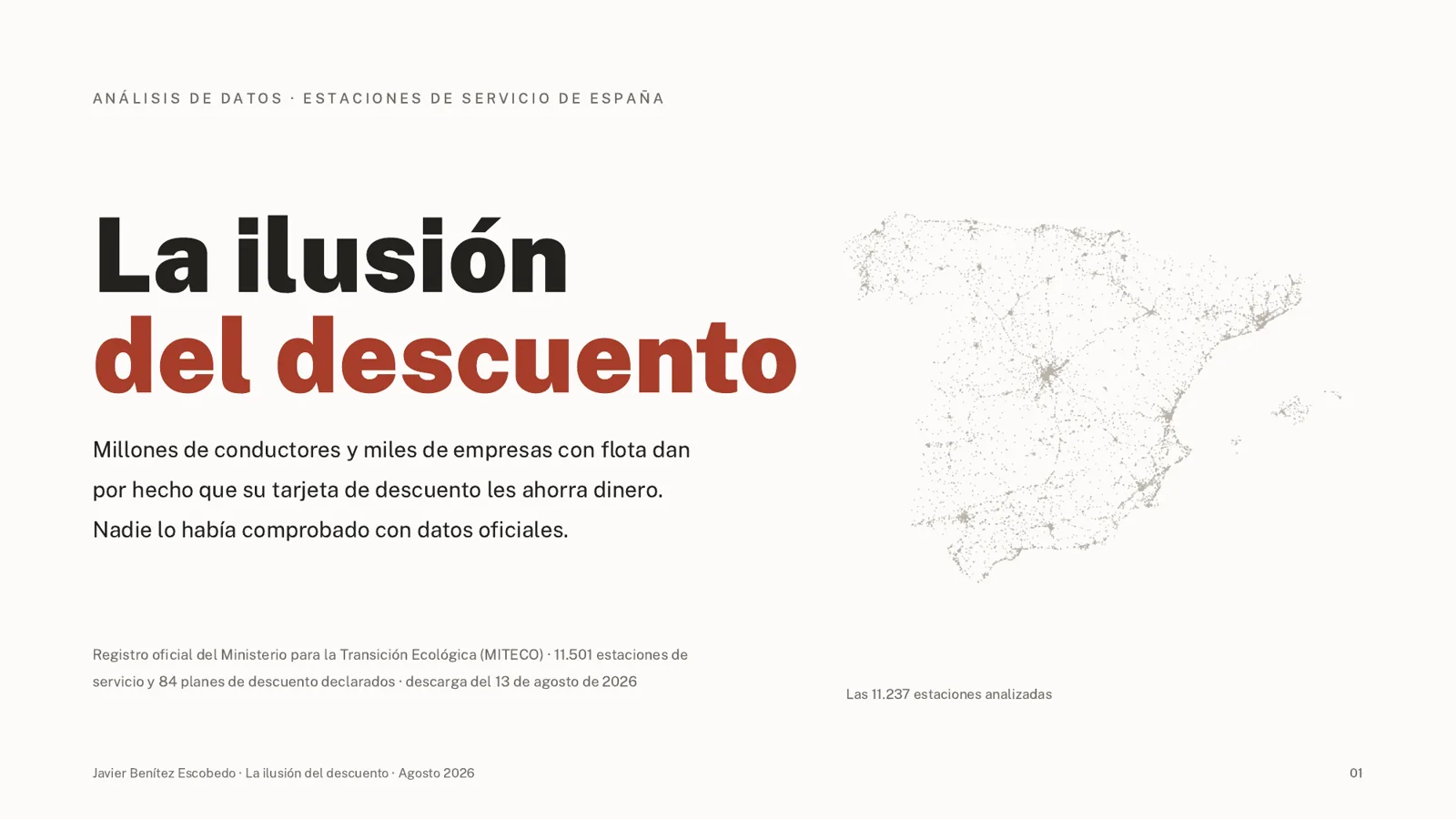
11,501
stations in the official register
11,237
analysed (264 in the Canary Islands, Ceuta and Melilla excluded)
84
plans declared by 23 operators
47
assessable for 95 petrol after removing non-comparable ones
The question
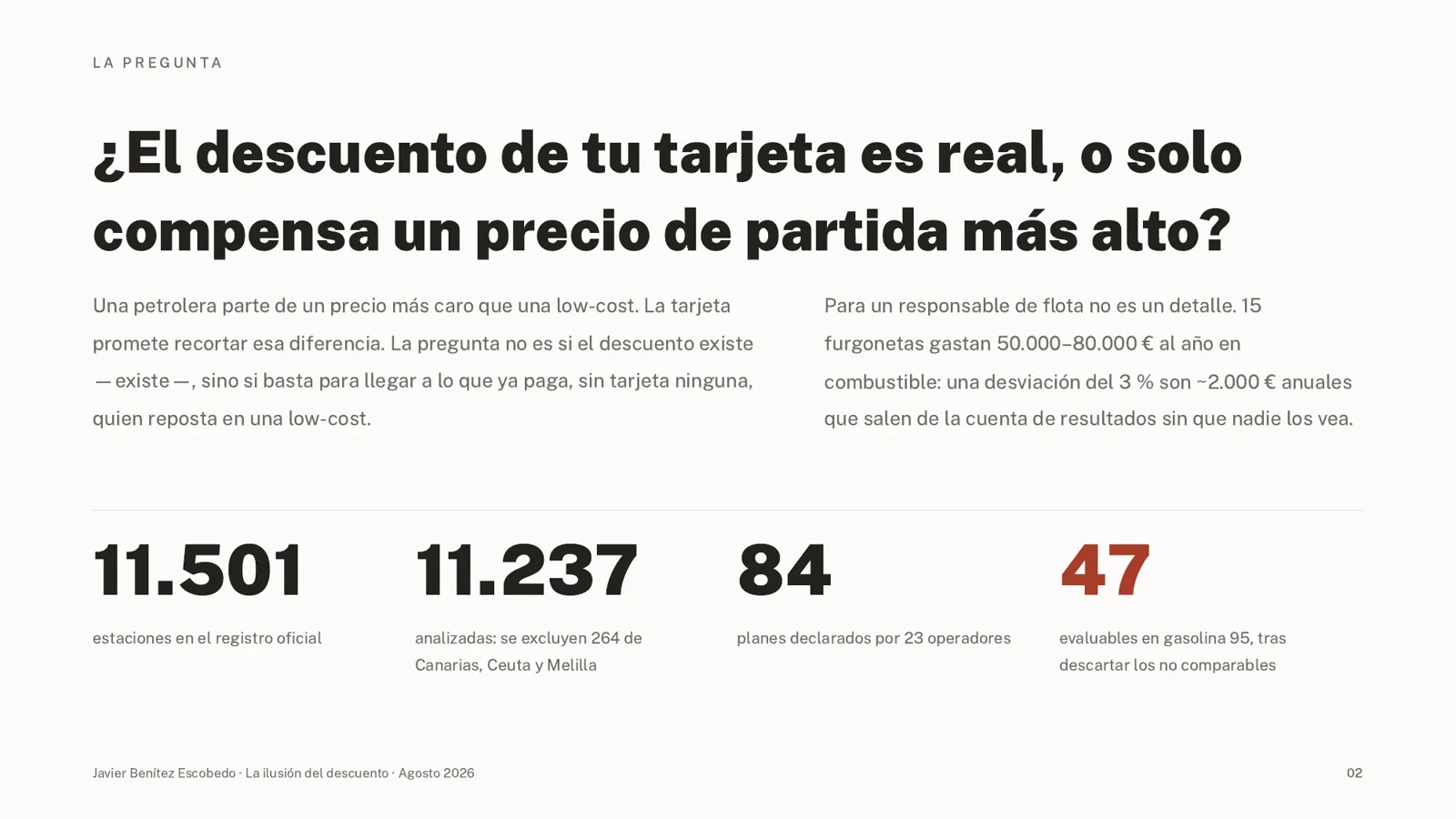
Is your card discount real, or does it only offset a higher starting price?
The question is not whether the discount exists, but whether it is enough to reach what a driver already pays, without a card, at a low-cost station.
Who it is for: a fleet manager. 15 vans spend €50,000–80,000 a year on fuel; a 3% deviation is about €2,000 a year.
The metric
Effective price against the low-cost threshold.
Formulaeffective price = operator's average base price − discount
worth it only if effective price < average low-cost price
What it signals
Whether, with the card, you end up paying less than someone filling up without a card at a low-cost station.
What it is not
It is not the saving compared with having no card (that is always positive, and it is the one companies advertise). It does not measure the discount; it measures whether the discount is enough.
Example · Repsol, 95 petrol: base €1.771 − €0.030 (Repsol Más Visa) = €1.741, against a low-cost threshold of €1.614. It falls short by 12.7 cents (15.9 cents for diesel).
The starting point
Before discounts, oil companies start 15.0 cents above low-cost stations for 95 petrol and 17.7 cents for diesel.
| Type | 95 petrol | Stations | Diesel |
|---|---|---|---|
| Oil company | €1.764 | 5,305 | €1.892 |
| Independent | €1.665 | 4,514 | €1.781 |
| Supermarket | €1.619 | 395 | €1.749 |
| Low-cost | €1.614 | 1,023 | €1.715 |
Twist 1 · distrust the striking figure
The finding that turned out to be a different tax system.
A Canary Islands subsidiary of DISA appeared as the only oil company whose discount paid off. The reason: the Canary Islands apply a 7% IGIC instead of 21% VAT. 95 petrol averages €1.492 there, 12.2 cents below the mainland threshold before any discount.
Decision: 264 stations and 16 plans are excluded. It was not a commercial advantage; it was a different tax regime.
The funnel
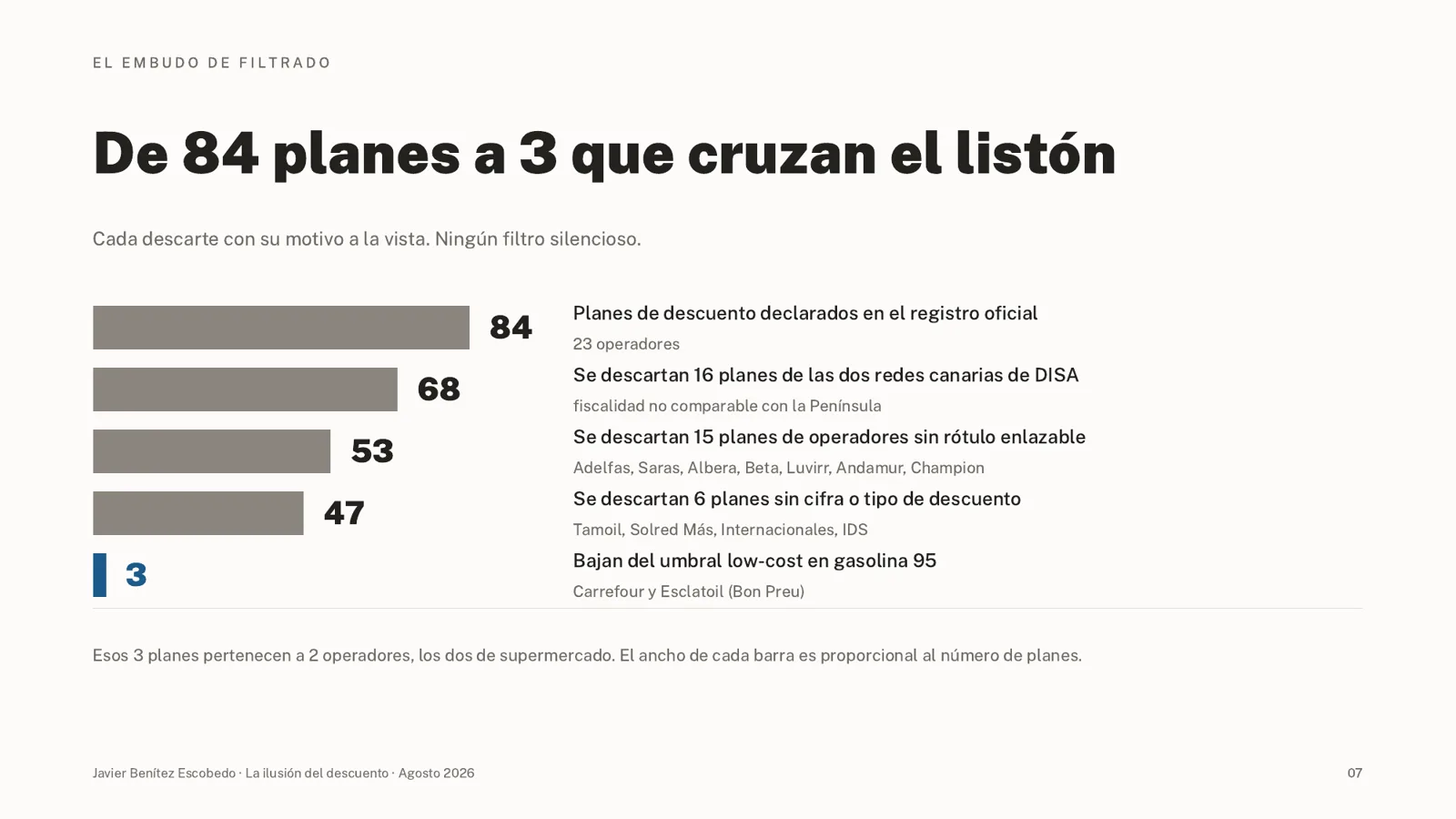
From 84 plans to 3.
- Declared in the official register23 operators
- Without DISA's Canary Islands networks−16, non-comparable taxation
- With a brand that can be matched to stations−15 (Adelfas, Saras, Albera, Beta, Luvirr, Andamur, Champion)
- With a discount amount or rate−6 (Tamoil, Solred Más, Internacionales, IDS)
- Below the low-cost threshold for 95 petrolCarrefour and Esclatoil (Bon Preu)
Every exclusion with its reason in plain sight. No silent filters.
Findings
No oil company pays off. Those that do don't win because of the discount.
A · They pay off, but not because of the discount
Carrefour and Esclatoil go below the threshold for both fuels. Neither is an oil company.
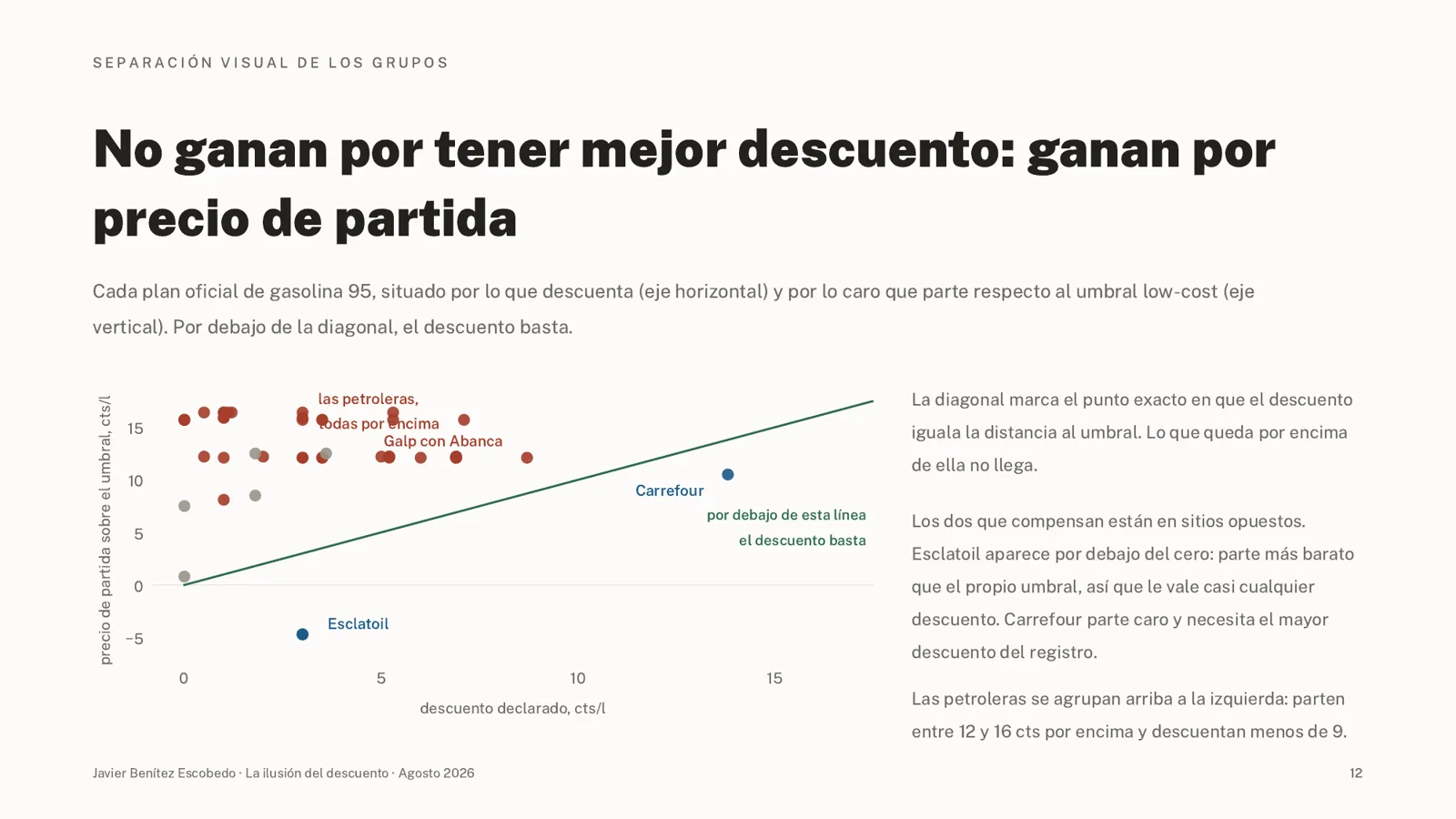
- Carrefour: the largest discount in the register (8%, 13.8 cents for 95 petrol). It starts at €1.719 → €1.581 with the discount: 3.3 cents below (1.9 cents for diesel). 146 stations in 41 provinces.
- Esclatoil: a discount of only 3 cents, but it already sells at €1.567, 4.7 cents below the threshold before the card. It wins on starting price. 71 stations, all in Catalonia (Barcelona 36 · Girona 18 · Tarragona 11 · Lleida 6).
B · They don't pay off
All 39 assessable oil company plans stay above the threshold.
The best in-house programme: 6.0 cents (Galp Flota Business), which still falls 6.1 cents short.
| Plan | Discount | Effective price | Short by |
|---|---|---|---|
| Galp con Abanca | 5% | €1.648 | 3.4 cents |
| Galp Flota Business | 6 cents | €1.675 | 6.1 cents |
| Euroshell | 2 cents | €1.716 | 10.2 cents |
| Repsol Más Visa | 3 cents | €1.741 | 12.7 cents |
| miBP | 3 cents | €1.743 | 12.9 cents |
| Cepsa Star | 1 cent | €1.768 | 15.4 cents |
Twists 2 and 3 · outside the register and triangulation
With the apps' real discounts, the conclusion holds.
Waylet (Repsol) does not appear in the MITECO file; Cepsa Gow declares 0.5 cents/litre but its app gives 5–6 cents/litre; miBP declares 3 cents/litre and matches the app.
With the app discounts: Waylet €1.721, Gow €1.723, miBP €1.743. None pays off. Waylet's theoretical maximum (20 cents/litre) does cross the line, but it requires signing up for electricity, gas, solar and insurance with Repsol.
By province
All 49 provinces on the mainland and the Balearic Islands have at least one low-cost station. Smallest gap: Balearic Islands, 9.6 cents; largest: Girona, 26.5 cents; average 15.4 cents. Not even in the most favourable province does the best in-house oil company discount close the gap (it would still be 3.6 cents short).
Limitations
What this analysis does not answer.
- It is a snapshot from 13/08/2026, not a time series.
- The discount is applied to the operator's average, not station by station.
- Private fleet agreements are not included.
- The cost of a detour and services (on-route network, car wash, café) are not included.
How to use it
The bar to beat: €1.614 for 95 petrol and €1.715 for diesel.
- Fleets: ask for the discount in cents per litre, not as a percentage; use the gap in your own province (9.6–26.5 cents); the benchmark to beat is 6.0 cents.
- Private drivers: with Carrefour or Esclatoil nearby, the card does pay off; with an oil company card and no need for its network, the low-cost station without a card is cheaper.
Conclusion
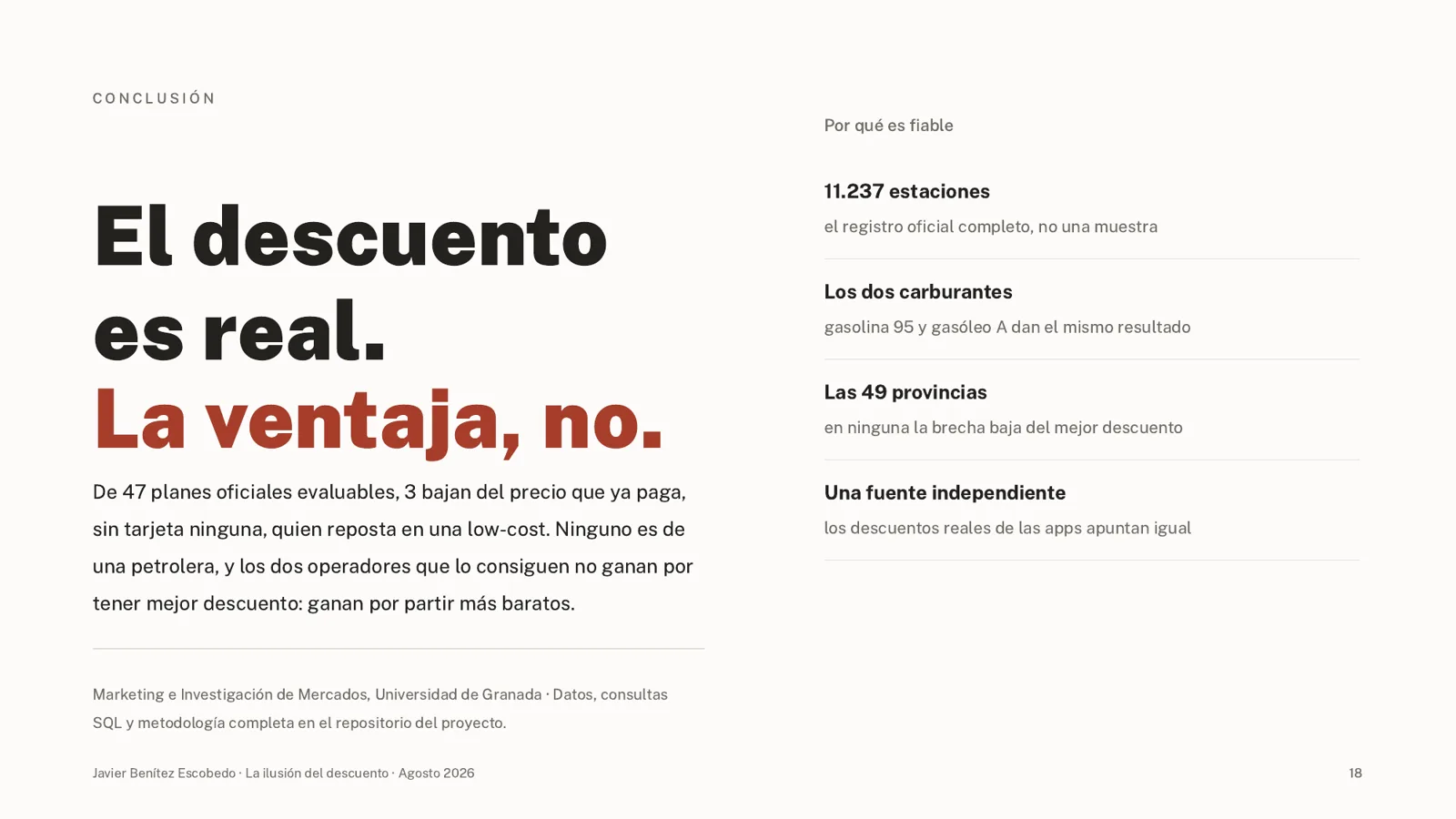
The discount is real. The advantage is not.
Of 47 assessable official plans, 3 go below the price a driver already pays, without a card, at a low-cost station. None belongs to an oil company, and the two operators that manage it do not win with a better discount: they win by starting cheaper.
Why it is reliable: 11,237 stations (the full register, not a sample) · two fuels with the same result · all 49 provinces · an independent source (the apps) points the same way.